Posts

Showing posts with the label #SWMM5

For Thesis Students: Visual INSTRUCTIONS FOR COMPILING SWMM5.DLL USING MICROSOFT VISUAL C++ 2010/2012

Image
For Thesis Students:  Visual INSTRUCTIONS FOR COMPILING SWMM5.DLL USING MICROSOFT VISUAL C++ 2010/2012 ========================= The following is based on the readme.txt for compiling that EPA distributes with the SWMM5 install 1. Open the file swmm5.c in a text editor and make sure that the    compiler directives at the top of the file read as follows:        //#define CLE        //#define SOL        #define DLL   or the DLL will be created 2. Create a sub-directory named VC2010_DLL under the directory where    the SWMM 5 Engine source code files are stored and copy SWMM5.DEF    and VC2010-DLL.VCPROJ to it. 3. Launch Visual C++ 2010 and use the File / Open command to open    the VC2010-DLL.VCPROJ file. 4. Issue the Build >> Configuration Manager command and select the    Release configuration. 5. Issue the Build VC2010-DLL command to build SWMM5.DLL   ...
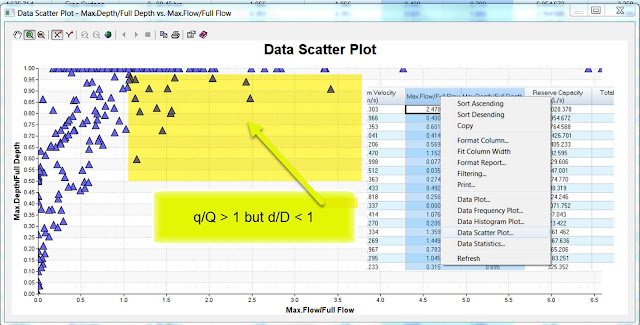
How to Use Scatter Plots in the DB Output tables of #InfoSWMM for d/D and q/Q

Image
How to Use Scatter Plots in the DB Output tables of #InfoSWMM All of the SWMM5 output tables are available in the output report manager of InfoSWMM and H2OMap SWMM.  A key output table is the conduit summary table where the maximum link values are shown.  You can use the right mouse click to see the statistics, plot, frequency plot, histogram graph and scatter graph for the selected column.  If you select two columns you can make a scatter plot.  An interesting scatter graph is the d/D or capacity of the pipe versus q/Qfull for the pipe.  Qfull is based on the full pipe depth, area and hydraulic radius using the bed slope.  Due to the fact that InfoSWMM, SWMM5 and H2OMap SWMM use the full St. Venant solution you can have a q/Qfull greater than 1 when the d/D is less than 1.  Here are some St. Venant solution in SWMM5 blogs for reference. http://www.swmm5.net/search/label/St.%20Venant http://www.swmm5.net/2016/10/more-st-venant-equations-in-swmm5.h...

Update for [USEPA/SWMM-EPANET_User_Interface] MTP 3

Image
Just a note about the great work being done on the new EPANET and SWMM 5 QGIS interface. This is the third Minimum Testable Product, released for testing of specific functionality. This is not a fully functional product and is not suitable for production use. — You are receiving this because you are subscribed to this thread. View it on GitHub  

More St Venant Equations in #SWMM5

Image
This blog shows the relationship between the terms dq1, dq2, dq3 and dq4 in the SWMM5 code and the St. Venant Partial Differential Equations. dq2 = Time Step * Area wtd * (Head Downstream – Head Upstream) / Link Length or dq2 = Time Step * Area wtd * (HGL) / Link Length Qnew = (Qold – dq2 + dq3 + dq4) / ( 1 + dq1) when the force main is full dq3 and dq4 are zero and Qnew = (Qold – dq2) / ( 1 + dq1) The dq4 term in dynamic.c uses the area upstream (a1) and area downstream (a2), the midpoint velocity, the sigma factor (a function of the link Froude number), the link length and the time step or dq4 = Time Step * Velocity * Velocity * (a2 – a1) / Link Length * Sigma the dq3 term in dynamic.c uses the current midpoint area (a function of the midpoint depth), the sigma factor and the midpoint velocity dq3 = 2 * Velocity * ( Amid(current iteration) – Amid (last time step) * Sigma dq1 = Time Step * RoughFactor / Rwtd^1.333 * |Velocity| The weighted area (Awtd) is used in the dq2 term of the St...

#SWMM5 1-D St Venant Equation Terms

Image
Overview In this blog we show how the St Venant terms are used in SWMM5 as equations, table, graphs and units. We use a QA/QC version of SWMM 5 that lists many more link, node, system and Subcatchment variables than the default SWMM 5 GUI and engine. This also applies to #InfoSWMM and any software the uses the #SWMM5 engine. SWMM5 is using is the most advanced equations as it takes into consideration the full dynamic (St. Venant) equations and not the more simplified kinematic wave / manning equations. The manning equation only considers the uniform flow conditions which represents a situation where the gravitational force on a column of water (due to the channel slope) balances out the frictional force. The full dynamic equations contains additional factors that affect the movement of water in a conduit or channel. These include the pressure force due to variation of depth along the length of the channel and the inertial (or convective acceleration) effect due to variation of flow ar...

Comparison of Three Different ModellingApproaches for the Simulation of Flooding Urban Areas - InnoAqual

Image
Comparison of Three Different ModellingApproaches for the Simulation of Flooding Urban Areas http:// udm2015.org/wp-content/upl oads/2015/05/Fuchs-UDM-2015-Comparison.pdf   … Comparison of Three Different Modelling Approaches for the Simulation of Flooding Urban Areas from InnoAqua

Why is a Hot Start File important in SWMM 5 and InfoSWMM

Image
A Hot Start File in InfoSWMM  or SWMM 5 is important as it provides initial   depths, initial flows and  initial settings for the hydrology and hydraulics features of the SWMM 5 engine.    You  have three options: Save a hot Start File at the  end of the  simulation, Use a hot Start File  at the beginning of  the simulation, Create a hot start file  from  the a  time during  the  Map Display If you change any of the network  types or add new links and nodes then  the Hot Start file needes to be recreated.  InfoSWMM use the Tab File in  the Run Manager to name the Hot Start File (Figure 1).   Each and  every Scenario in InfoSWMM  can  use or Save a different scenario with different starting  and ending  times  (Figure 2).  If you USE  a Hot  Start  File then: The  new  simulation  starts at the end  of  the  ol...

Innovyze Further Expands RDII Analyst Functionality, Setting New Standard for Sanitary and Combined Sewer System Model Calibration

Innovyze Further Expands RDII Analyst Functionality, Setting New Standard for Sanitary and Combined Sewer System Model Calibration New Features Allow Unprecedented Analysis and Comparison of Rainfall-Derived Inflow and Infiltration Data, Parameters for Complex Sewers Broomfield, Colorado, USA, February 23, 2016 Innovyze, a leading global innovator of business analytics software and technologies for smart wet infrastructure, today announced the newest release of its  RDII Analyst  (Rainfall-Derived Inflow and Infiltration) for  InfoSWMM  and  H 2 OMAP SWMM . The new version delivers expanded functionality, incorporating many advanced Genetic Algorithm (GA) optimization features. It increases its unmatched productivity by openly inviting the users to further adjust the dry weather flow (DWF) and RTK parameters (with initial and maximum monthly storages for continuous simulation) to achieve a better fit and ultimately a better model based on their experiences. The ...

RDII and DWF Analyst for InfoSWMM and H2OMap SWMM, #SWMM5, #INFOWORKS_ICM

RDII and DWF Analyst for InfoSWMM and H2OMap SWMM from Robert Dickinson on Vimeo .

Innovyze RDII Analyst for the Analysis and Calibration of RDII, DWF, DWF Patterns and GWI in Sewer Collection Systems

Image
One of the most powerful InfoSWMM and H2OMAP SWMM Application Tools from Innovyze is RDII Analyst.  RDII Analyst will separate out the Groundwater base flow, Dry Weather Flow (DWF), DWF Patterns, estimate the Wet Weather flow component or RDII  Rainfall -Derived Infiltration Inflow (I&I) and use a Genetic Algorithm to find  the best fit 12 RTK parameters for RDII modeling.  This powerful tool can  be used for RTK flow in InfoSWMM, H2OMAP SWMM, InfoSewer, SWMM 5 and InfoWorks ICM.  Figure 1 shows one of the  end results of RDII Analyst – a correlation plot of Observed versus Calibrated RDII Volume for the simulated events. RDII Analyst is a significant improvement over the EPA SSOAP program, performs QA/QC of rainfall and flow monitoring data and decomposes the flow data into Dry-Weather Flow (DWF) and Wet-Weather Flow (RDII) components using criteria such as rainfall threshold. The DWF component is further analyzed to construct a DWF pattern t...

A few connected tweets about #LID or #SuDS, #SWMM5, #INFOSWMM, #YOUTUBE and #INFOSEWER

Image
A few connected tweets about #LID or #SuDS, #SWMM5, #INFOSWMM, #YOUTUBE and #INFOSEWER Innovyze  ‏ @ Innovyze     14h 14 hours ago via @ WatershedCenter Low impact development # SuDS a natural way to manage # stormwater . http:// bit.ly/1OmTzh1   2/ One of the Subscribed H&H Channels is https://www. youtube.com/user/Innovyze/ playlists   … for all @ Innovyze Software on YouTube 1/ The YouTube channel https://www. youtube.com/user/SWMM5/pla ylists   … is getting close to 15,000 views & subscribes to many H&H channels New Help Files for # INFOSWMM and # INFOSEWER include many hyperlinks to our Forum, Blog and http:// innovyyze.com  

Advanced Graphs in InfoSWMM v14 and H2OMap SWMM v14

Image

There was a change in EPA SWMM 5.1 to better represent Weekend vs Weekday Hourly flow patterns

There was a change in EPA SWMM 5.1 to better represent Weekend vs Weekday Hourly flow patterns Fields for the DWF Tables in H2OMap SWMM and InfoSWMM are: 1. Scenario Name 2. Junction ID for the node that receives the DWF 3. The item – either FLOW, MASS or Concentration (Use Blockedit to just set this at Flow for all Rows) and you should fix your problem. 4. Value – the flow in the units defined in the Run Manager 5. Pattern1 – Can be Weekend, Hourly (Weekday only), Monthly or Daily patterns.  They can be in any order but Hourly only applies Monday to Friday. 6. Pattern2 – Can be Weekend, Hourly (Weekday only), Monthly or Daily patterns. They can be in any order but Hourly only applies Monday to Friday. 7. Pattern3 – Can be Weekend, Hourly (Weekday only), Monthly or Daily patterns. They can be in any order but Hourly only applies Monday to Friday. 8. Pattern4 – Can be Weekend, Hourly (Weekday only), Monthly or Daily patterns. They can be in any order but Weekend only applies to Sa...